 SweepBoardby TRM
The sweep is the one part of an evacuation nobody can see
Alarms are tested weekly. Extinguishers are serviced annually. Yet the step that proves the building is empty still relies on people walking back to say "I think my area is clear".
Three minutes of not knowing
A fire warden’s job is simple to describe: check every part of your area, make sure nobody is left, report to the person in charge. The weak point is the report.
In a typical evacuation the incident controller stands at the assembly point or the alarm panel and waits. Wardens arrive in ones and twos. Some report, some assume a colleague has. One is covering a floor they do not normally work on. The controller builds a picture in their head, usually while dealing with the alarm panel, the landlord, the public and a phone that will not stop ringing.
When the fire service arrive, the handover depends on that mental picture being right.
Was the stockroom checked?
A missed area is rarely noticed on the day. It shows up at the debrief, or not at all.
Is anyone in the refuge?
A person waiting for assistance on a stair landing needs the controller to know they are there, immediately.
How long did it really take?
Without time stamps, evacuation times are a guess. Improvement cannot be measured.
Who was the warden today?
Shift patterns, holidays and agency staff mean the named warden is often not the person who swept.
Could you answer these the morning after a real fire?
They are the questions an enforcing authority, an insurer, a landlord or your own board will ask.
Which areas were confirmed clear, and when?
Not which areas were supposed to be checked. Which ones were, with a time against each.
Who confirmed them?
A name against every area, including the cover warden who stepped in on the day.
What did they find?
Blocked routes, wedged fire doors, people who refused to leave, areas that could not be reached.
When did you know the building was clear?
The exact time of the final area, the roll call and the outcome for every refuge.
SweepBoard answers all four before you leave the assembly point.
Paper and radios compared with a live sweep board
| Paper sheets, radios, word of mouth | SweepBoard | |
|---|---|---|
| Alerting wardens | Relies on hearing the alarm and remembering the role | Alarm plus a phone alert naming the floor to sweep, with reminders |
| Controller’s view | Built from verbal reports as people arrive | Live floor plan. Each area turns green, orange or red as it is checked |
| Missed areas | Found later, if at all | Unswept areas stay grey on the board until someone checks them |
| Issues found | Mentioned in passing, often forgotten | Logged by the warden in one tap with a note, time and name |
| Refuges | A runner or a radio message | Flagged on the board with number of people and assistance needed |
| Fire service handover | From memory | Areas clear, issues, refuges in use and site hazards on one screen |
| Timing | A stopwatch, or an estimate | Every action stamped to the second, automatically |
| The record | Written up afterwards and filed | Saved at stand down. Searchable history for every site |
| Learning from drills | Anecdotal | Compare clear times and recurring issues drill to drill |
The difference on the day, and the day after
Faster, calmer control
The controller stops chasing reports and starts managing the incident. Gaps are obvious, so they are closed quickly.
Confidence in the all clear
The all-clear time is only stamped when every area is swept and no refuge is in use. It cannot be assumed.
Evidence without effort
The report is a by-product of doing the sweep. There is nothing to write up, chase or file.
Wardens who know their route
The sweep list is the route. New, cover and agency wardens follow the same list as everyone else.
Drills that teach something
See which areas are slow, which issues repeat and which floors need more wardens.
Visibility across the estate
Head office can see that drills are happening, how long they take and what they find, site by site.
SweepBoard supports your procedure. It does not replace it.
The alarm system raises the alarm. Trained wardens do the sweep. SweepBoard makes the sweep visible and recorded.
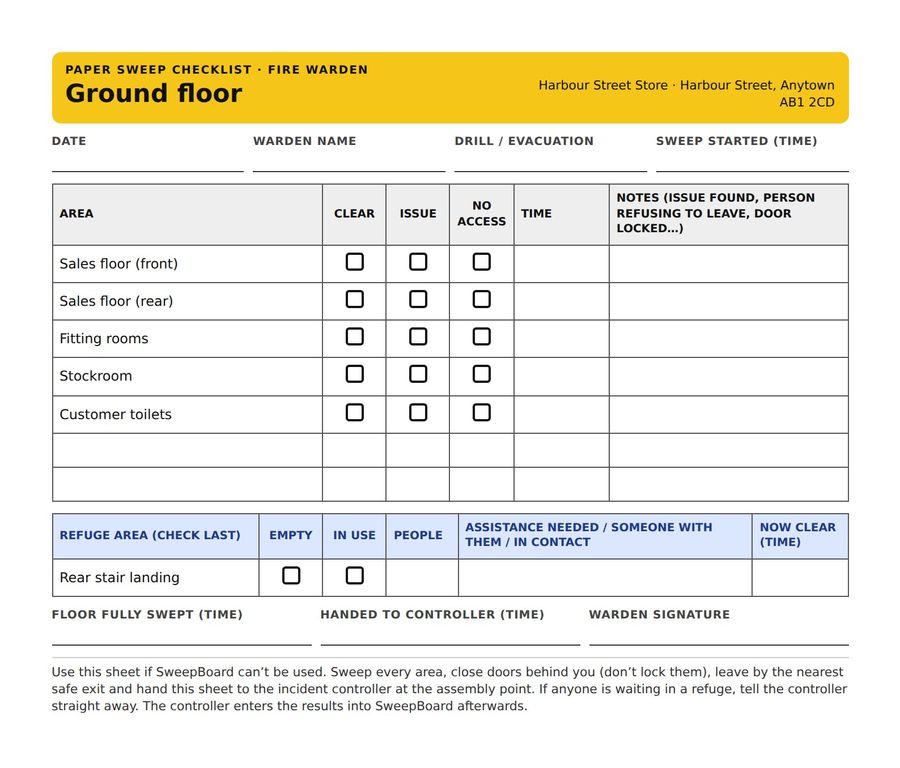
That is why every site also gets printable paper checklists, and why the app keeps working without a signal. If a phone is flat or the network is down, the evacuation carries on exactly as it would have before.
Find out what your next drill is really telling you
Run one drill with SweepBoard on one site. Compare the report with your last paper record.